
1. Direct Answer
A stepper motor datasheet tells you whether a specific motor fits your machine before you request a quote or place an order. Read it in a fixed order: confirm the motor type and model, check voltage and current, review step angle, holding torque and speed, then verify wiring, dimensions and operating conditions. Because suppliers use different terminology, units and test methods, never compare two values unless you know what each number means and how it was measured.
Short version: check the model first, match the electrical ratings to your driver, confirm whether each value refers to the rotor or the gearbox output, compare only like-for-like torque values, and verify dimensions from a dimensional drawing — not a photograph.
2. Which Motor Type and Model Number Should You Confirm First?
In short: confirm the motor family (permanent magnet, variable reluctance or hybrid) and the exact model number before comparing anything else, because every other rating on a stepper motor datasheet depends on which design and which variant you are actually reading.
You will find this information on the datasheet itself; however, many variations exist within each design family. Two motors with a similar appearance can behave very differently.
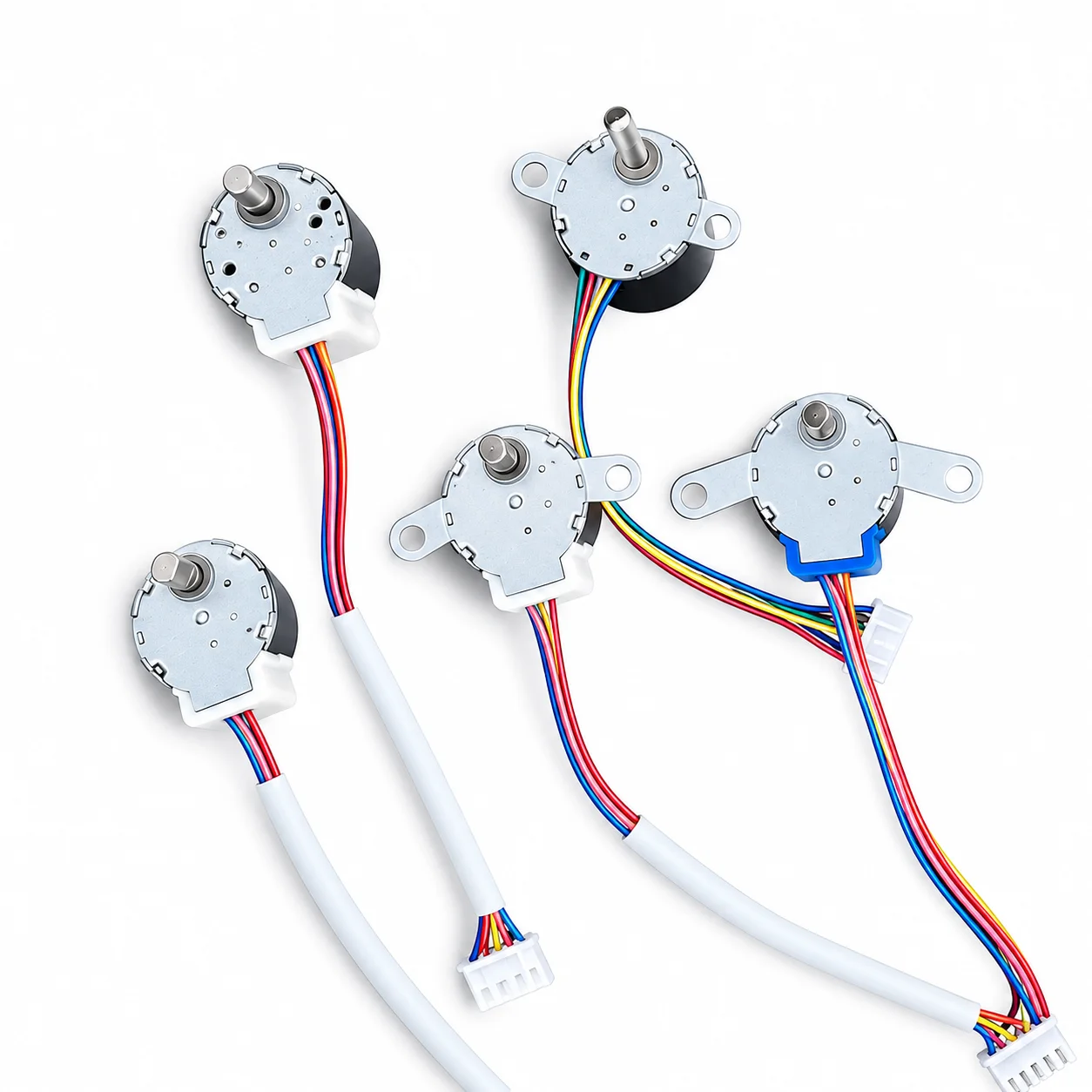
You should also determine whether your motor includes a gearbox, a lead screw or another type of power transmission component. The output shaft of a geared motor rotates at a rate set by the gear ratio, not by the rotor itself, so verify that the datasheet states which values apply to the motor and which apply to the gearbox output.
The most reliable way to select the right motor is to contact your supplier and ask for the current datasheet and dimensional drawing of the exact model that has been quoted to you.
3. What Do the Voltage and Current Ratings Actually Mean?
In short: voltage describes how much electric charge is built up in a winding, while current describes how fast that charge flows; a stepper motor datasheet may list winding voltage, phase current, rated current or a suggested driver setting, and these numbers are not interchangeable.
Voltage and current are two of the most commonly used measurements in electronics, yet the two terms should not be confused. Mixing them up leads to wrong driver choices and unexpected heating.
Datasheet term | What it describes | What to confirm before ordering |
Winding voltage | Voltage built up across the motor winding | Whether it is a rated value or a test-condition value |
Phase current | Current flowing through one phase while operating | Whether the value is per phase, peak or RMS |
Rated current | The continuous current the winding is designed for | The temperature conditions behind the rating |
Suggested driver setting | The current the manufacturer recommends on the driver | Which driver family the recommendation applies to |
3.1 How Do You Choose the Right Driver and Current Setting?
In short: the driver and its current setting decide whether the motor delivers its rated torque or overheats in service.
Excessive current causes a stepper motor to overheat, and a poorly matched driver or current setting reduces the torque actually available. Confirm that the datasheet states winding voltage, phase current, rated current or a suggested driver setting.
If the datasheet is ambiguous, contact the manufacturer and verify which drivers and settings are most appropriate for your application.
4. How Does Step Angle Affect Resolution and Positioning?
In short: step angle is the rotation produced by one full step under a given drive method; a smaller step angle gives more commanded positions per revolution but does not by itself guarantee a more accurate system.
Actual travel depends on the motor, the driver, the load, the mechanical drive system and the installation quality.
Positions per revolution = 360° ÷ step angle. Example: 360° ÷ 1.8° = 200 full steps per revolution.
4.1 How Does a Gearbox Change the Stated Step Angle?
In short: on a geared stepper motor the datasheet step angle may refer to the rotor or to the output shaft, and the gear ratio converts one into the other.
The gearbox changes the ratio between rotor rotation and output movement, so you must know which part of the motor the stated step angle applies to before you compare geared motors or calculate the movement of anything attached to the output shaft.
Output-shaft step angle ≈ rotor step angle ÷ gear ratio. Always confirm with the supplier which value the datasheet states.
If your application requires consistent positioning, evaluate the entire mechanical system during testing instead of judging the motor by its step angle alone.
5. How Should You Interpret Holding Torque and Torque at Speed?
In short: holding torque is what an energized motor can resist at standstill under specified conditions; it is not the torque available while moving, and usable torque usually falls as speed rises.
Stepper motors deliver different torque levels at different speeds. At higher speeds the usable torque is typically lower than at low speeds. The driver type, the power supply, the winding design and the driven load all influence how the system performs.
Unit check before comparing: 1 N·m ≈ 141.6 oz·in. Confirm the unit and the test method whenever a torque value has no unit printed next to it.
5.1 Which Torque Values Can Be Compared Directly?
In short: only torque values of the same type, in the same unit, measured under the same conditions can be compared directly.
When reviewing a torque value, identify whether it is holding torque, pull-in torque, pull-out torque or output torque after a gearbox. Each type describes a different situation, so they cannot be compared with each other.
Torque type | What it means | Directly comparable with others? |
Holding torque | Torque an energized motor resists at standstill under specified conditions | No — standstill value only |
Pull-in torque | Torque available while the motor can start and follow a given speed without losing steps | No — depends on start conditions |
Pull-out torque | Maximum torque while running at a given speed without losing synchronism | No — running value, speed-dependent |
Output torque after gearbox | Torque available at the gearbox output shaft | No — includes the gear ratio effect |
Check that the application will start with the required torque, run within its specified speed range, and tolerate the load changes that can occur in service.
6. What Winding and Connection Information Should You Verify?
In short: winding resistance, inductance, phase count and the wiring schematic tell you whether the motor will work with your driver, and two motors that look alike can still be wired differently.
The engineering data on a stepper motor datasheet usually includes winding resistance, inductance and the number of phases, plus a schematic of how the motor should be wired. Engineers use this information to choose a suitable driver.
Wiring detail | Why it matters before ordering |
Wire type | Affects temperature rating, flexibility and connector options |
Number of leads | Determines which drive modes (unipolar/bipolar) are possible |
Winding scheme around the core | Changes resistance, inductance and torque behaviour |
Connection type (series/parallel) | Sets the correct current and voltage for the driver |
Lead order | Wrong order reverses rotation or prevents operation |
When replacing an existing motor, verify that the new motor meets the same electrical connection and drive requirements and that its physical dimensions are compatible.
7. Which Dimensions and Mechanical Details Must Match Your Machine?
In short: mechanical fit matters as much as electrical function — body size, mounting holes, shaft diameter and length, gearbox or lead-screw size and connector positions must all match the drawing.
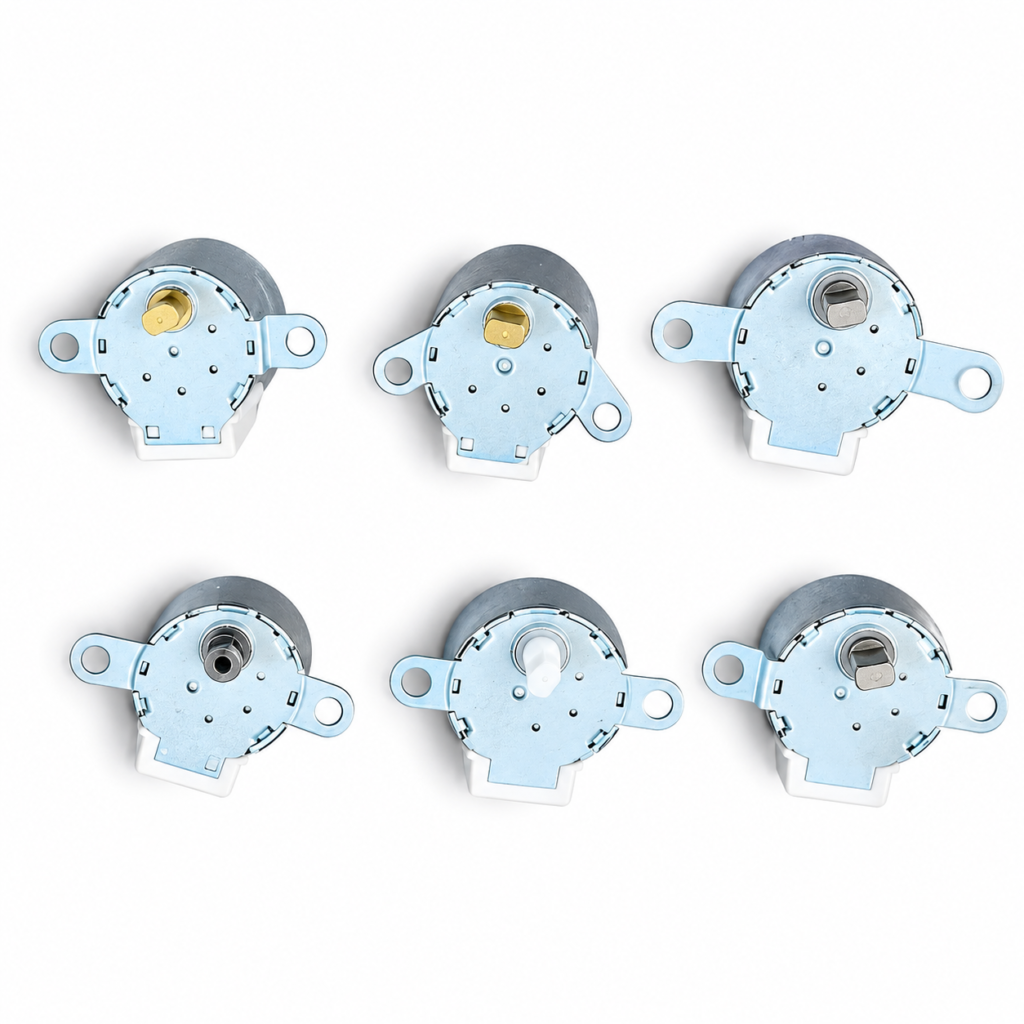
Dimensional drawings on a stepper motor datasheet are more reliable than product photographs because they show where to measure and what tolerance applies to each measurement. Always check whether the drawing uses millimetres or inches.
Dimension | Why it matters | Note |
Body size | Space envelope inside your machine | Check frame designation, e.g. common NEMA sizes |
Mounting hole positions | Determines whether the motor bolts onto your bracket | Verify pilot diameter as well |
Shaft diameter and length | Couples to pulleys, gears or lead screws | Confirm tolerance class |
Gearbox or lead-screw size | Adds length and changes the output spec | State values apply to output, not rotor |
Connector location | Affects cable routing and assembly | Check connector type and exit direction |
Also verify the shaft shape, the mounting orientation and the position of the electrical connectors. Even a slight deviation from the specified values can prevent the motor from fitting into your mechanism.
8. Which Operating Conditions and Limits Deserve a Second Look?
In short: operating temperature, duty conditions, insulation data and environmental limits tell you whether the motor survives your working environment — and continuous capacity at rated load should never be assumed.
Take note of the operating temperature range, duty conditions, insulation information and environmental limitations given by the manufacturer. These facts show whether the motor suits your equipment in its actual working environment.
A motor’s continuous running capacity at its highest rated load or speed should not be assumed. Actual performance depends on heat dissipation, mounting, ventilation, the driver setting and the application.
If the stepper motor datasheet does not explain how a value was determined, contact the vendor and ask for the test basis.
9. What Should You Ask the Supplier Before Ordering?
In short: send the supplier your application requirements, then request the exact model name, the current datasheet and dimensional drawing, and written clarification of any value that is unclear.
Before you approve a stepper motor datasheet for ordering, work through the comparison in a fixed sequence so nothing is missed:
- Confirm both models are the same motor type and that both documents are the latest revisions.
- Normalise the units before comparing any number (mm vs inch, N·m vs oz·in).
- Check whether each value refers to the rotor or to the gearbox output shaft.
- Compare only like-for-like torque types tested under the same conditions.
- Verify wiring, connector and mounting details against your machine.
- Log every value the datasheet does not explain and ask the supplier to confirm it in writing.
9.1 Which Application Details Should You Provide?
Provide the supplier with your application requirements before approval:
- What load must the motor move or hold?
- What speed and movement distance are required?
- Does the application need continuous or intermittent operation?
- What power supply and driver are available?
- Which installation dimensions and shaft details must match?
- What temperature and environmental conditions will the motor face?
Then ask the supplier for the exact model name, the most current datasheet and dimensional drawing for that model, and clarification of any value that seems unclear. For a direct replacement, include the current motor label, existing wiring details and the mounting dimensions of the installed motor if available.
10. FAQ
Is a higher holding torque always better?
No. The motor needs enough torque for the job, but a larger motor may demand more space, current and budget. Choose based on the force you need and the conditions the motor will run in.
Does a smaller step angle always mean higher accuracy?
No. Step angle measures the commanded movement per step. Overall accuracy depends on the motor, driver, load, mechanical components and assembly quality.
Can I compare torque values from different suppliers directly?
Only when the torque type (peak vs continuous), the unit (N·m vs lb-ft) and the test conditions match. For geared motors, also confirm whether the value applies to the motor shaft or the gearbox output.
What if a datasheet is incomplete?
Request the missing data, the current dimensional drawing and confirmation that the motor was tested under normal conditions — all before ordering.
Do I still need a dimensional drawing if I have product photos?
Yes. Photos do not show measurement points or tolerances, while a drawing defines both, so a drawing is the reference for any fit check.
Can I assume the motor runs continuously at its rated load?
No. Continuous capacity depends on heat dissipation, mounting, ventilation and the driver setting, so verify the duty conditions with the supplier.
11. Conclusion
A thorough review of a stepper motor datasheet prevents electrical, mechanical and performance mismatches before they reach production. Review the motor type, voltage and current, step angle, torque definitions, wiring, dimensions and operating conditions — and only compare values that are defined and tested in the same way.
When evaluating geared stepper motors in frame sizes such as Φ15–Φ46, clear technical documentation improves the quality of every conversation with a supplier. To discuss a specific application and obtain the datasheet and dimensional drawing for the model you are interested in, contact Changzhou Xinghua Electric Co., Ltd. through czxhmotor.com.