
1. What Is a Stepper Motor?
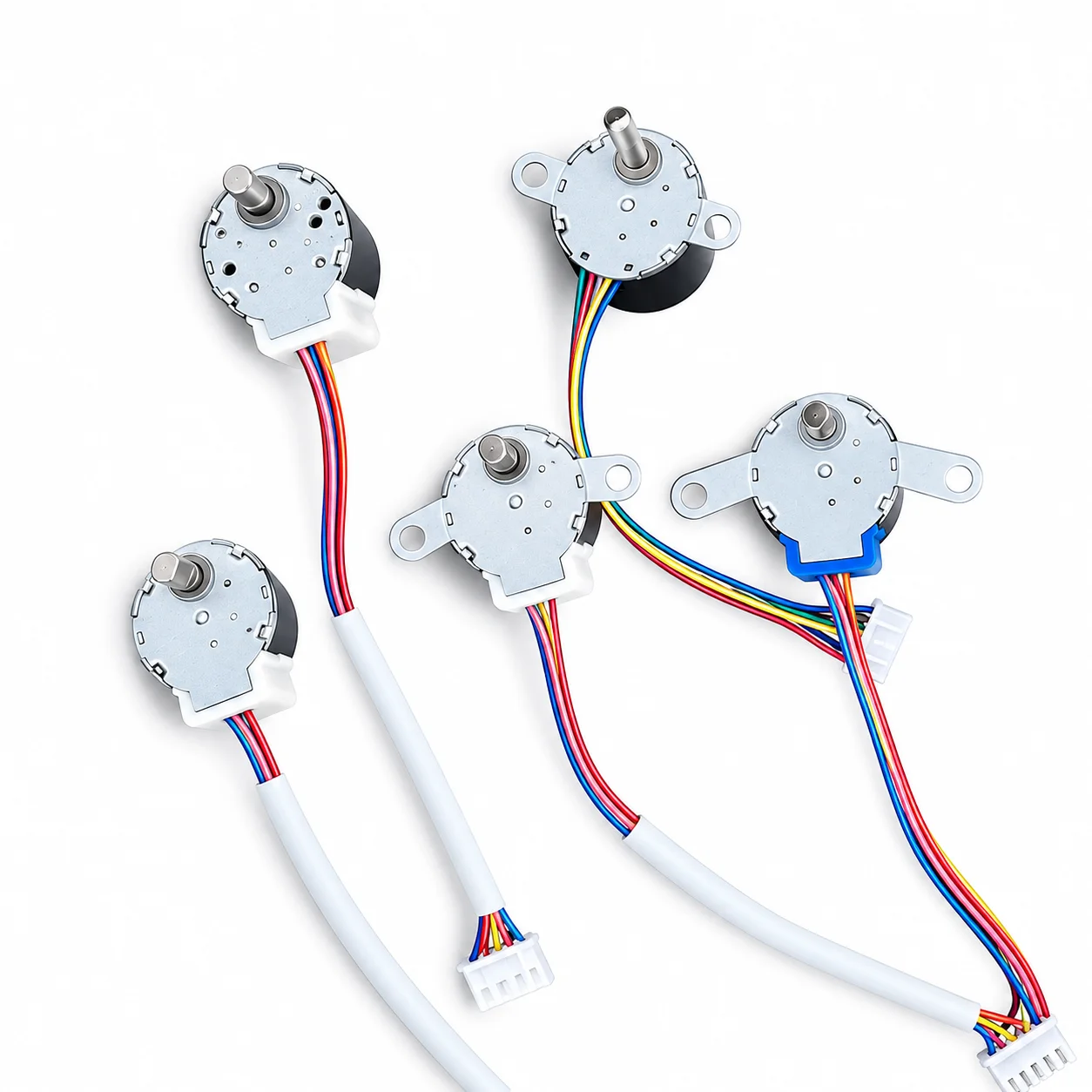
A stepper motor is an electric motor that moves in discrete angular increments when its driver energizes the motor windings in a controlled sequence. Unlike a conventional motor designed primarily for continuous rotation, it supports positioning through commanded steps.
This operating principle makes stepper motors useful in automation systems that require predictable movement. Examples include linear positioning tables, dispensing equipment, laboratory instruments, and compact manufacturing machinery.
How Does a Stepper Motor Differ from a Conventional Motor?
A conventional motor often operates continuously at a target speed. A stepper motor instead receives movement commands through electrical pulses. The number of pulses determines the commanded displacement, while pulse frequency determines the commanded stepping rate.
For example, a controller can command a motor to rotate through a specified angle by sending a corresponding number of pulses. The driver translates those commands into current changes within the motor windings.
However, commanded position does not always equal actual position. Excessive loads, poor acceleration settings, or insufficient torque can cause missed steps in an open-loop system.
What Are the Main Benefits of a Stepper Motor?
Stepper motors offer several practical advantages:
- Position control: The controller can command movement through a defined number of steps.
- Simple motion commands: Many systems use pulse-and-direction signals.
- Holding torque: An energized motor can resist external rotational forces while stationary.
- Repeatable movement: Properly sized systems can repeat positioning sequences consistently.
- Flexible speed control: The controller adjusts pulse frequency to change stepping speed.
- Compact integration: Various frame sizes support different equipment layouts.
These benefits make stepper motors suitable for many positioning tasks. Nevertheless, the actual performance depends on motor design, driver settings, mechanical transmission, and load conditions.
2. How Does a Stepper Motor Work?
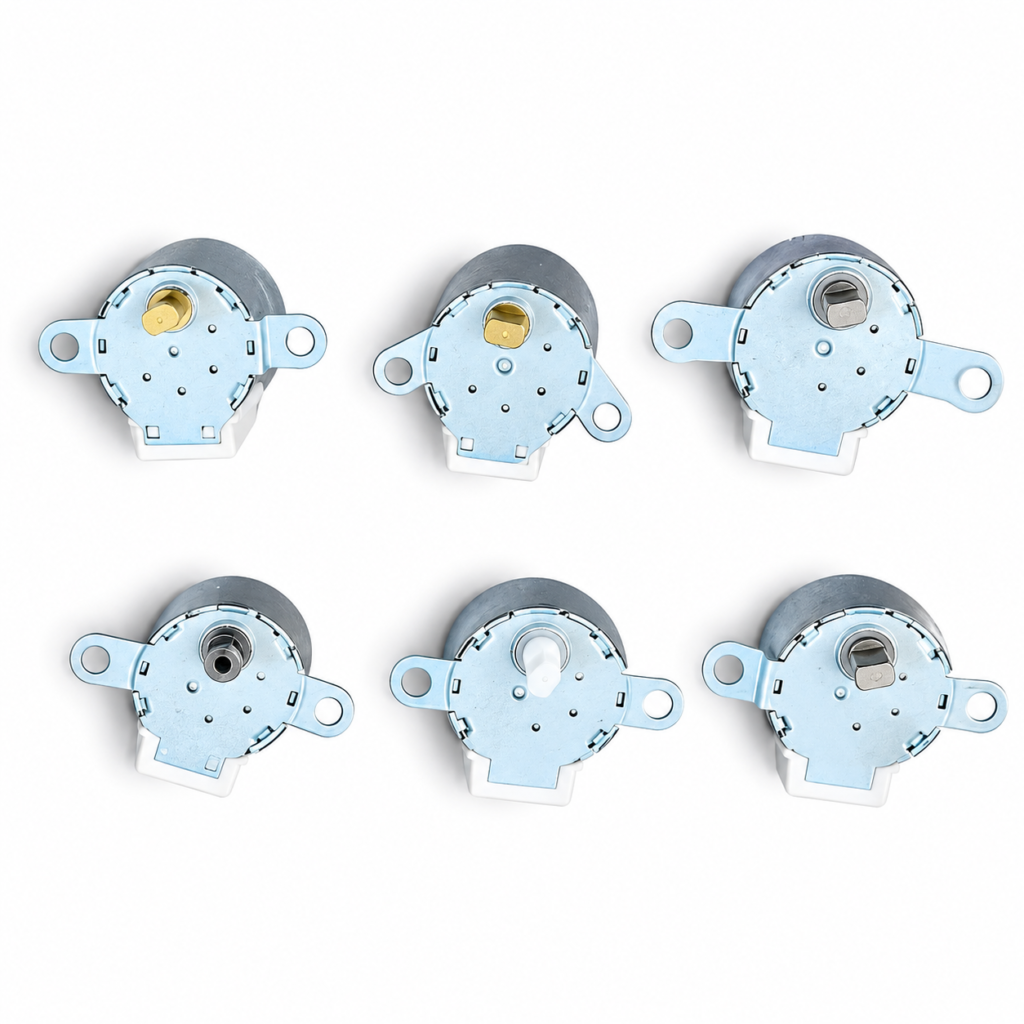
A stepper motor works by switching electrical current through its windings in a controlled sequence. The resulting magnetic fields interact with the rotor, causing it to move toward successive equilibrium positions.
What Happens During Each Step?
The basic operating process follows four stages:
- The controller sends a pulse command to the driver.
- The driver energizes the appropriate motor windings.
- The magnetic interaction moves the rotor toward the next commanded position.
- Additional pulses produce further movement in the selected direction.
The driver controls winding current according to the motor’s electrical requirements. Therefore, motor and driver compatibility plays an important role in system performance.
How Do Step Angle and Pulse Frequency Affect Movement?
The step angle defines the angular displacement associated with one full step. A smaller step angle provides more full-step positions per revolution.
For an idealized motor without a gearbox, the commanded rotation can be calculated as follows:
For example, a motor with a 1.8-degree step angle requires 200 full steps for one revolution.
Microstepping allows the driver to subdivide full steps by adjusting winding currents. It can produce smoother motion and reduce vibration. However, microstep command resolution does not guarantee the same level of absolute positioning accuracy under load.
The relationship between pulse frequency and rotational speed is:
For a 1.8-degree motor receiving 1,000 full-step pulses per second, the ideal commanded speed is 300 RPM. Microstepping changes the pulse count required for the same shaft movement.
Why Does a Stepper Motor Lose Torque at Higher Speeds?
A stepper motor‘s available torque generally decreases as speed increases. At higher stepping frequencies, winding current has less time to rise, while electrical and mechanical effects influence the motor’s response.
The driver supply voltage, current settings, motor inductance, and load inertia all affect the available torque. Engineers should therefore review the speed-torque curve for the intended motor-and-driver combination instead of relying only on the holding-torque rating.
3. What Are the Main Types of Stepper Motors?
The appropriate motor type depends on positioning requirements, cost, load conditions, and control architecture. Hybrid, permanent-magnet, and variable-reluctance designs use different rotor structures and magnetic principles.
Hybrid Stepper Motor
A hybrid stepper motor combines permanent-magnet and toothed-rotor characteristics. It is commonly used where controlled positioning and useful torque are important.
Typical applications include CNC equipment, automated stages, inspection instruments, and industrial automation. The required frame size and winding configuration depend on the application.
Permanent-Magnet Stepper Motor
A permanent-magnet stepper motor uses a magnetized rotor that interacts with the stator’s magnetic field. Its characteristics depend on the design, including rotor construction and pole arrangement.
Designers may consider this type for compact mechanisms and relatively simple motion systems. Selection should still account for speed, torque, size, and control requirements.
Variable-Reluctance Stepper Motor
A variable-reluctance stepper motor uses a rotor made from magnetically permeable material. The rotor moves toward positions that reduce magnetic reluctance as the stator phases energize.
Its operating characteristics differ from those of permanent-magnet and hybrid designs. Engineers should compare actual performance data before choosing a motor for a specific application.
What Is the Difference Between Bipolar and Unipolar Stepper Motors?
Bipolar and unipolar describe winding configurations and current-control arrangements rather than the three rotor categories above.
Feature | Bipolar configuration | Unipolar configuration |
Winding arrangement | Typically uses phase windings without center taps | Commonly uses center-tapped phase windings |
Current control | Current direction reverses through each phase | Phase current uses selected winding sections |
Driver requirements | Requires bidirectional phase-current control | Can use a simpler switching arrangement |
Design consideration | Winding utilization and driver complexity | Winding utilization and available torque |
Selection basis | Motor wiring, current rating, and driver compatibility | Motor wiring, current rating, and driver compatibility |
The best choice depends on the motor’s electrical design and the system’s control requirements. Confirm the winding diagram before connecting a motor to a driver.
4. What Are the Key Stepper Motor Specifications?
A suitable stepper motor must meet both electrical and mechanical requirements. The most important specifications include torque, speed, step angle, rated current, winding resistance, inductance, and physical dimensions.
How Much Torque Does the Application Require?
Torque determines whether a motor can accelerate, move, and hold the intended load. Engineers should calculate the torque required by the mechanism and compare it with the motor’s available torque at the operating speed.
Three torque concepts deserve particular attention:
- Holding torque: The maximum specified torque at standstill under stated energization conditions.
- Pull-out torque: The maximum torque the motor can sustain at a particular running speed before losing synchronism.
- Required operating torque: The torque demanded by the actual mechanism during movement.
Holding torque is not a substitute for a running torque rating. The motor may provide considerably less torque at the target speed.
What Is the Difference Between Step Angle and Positioning Accuracy?
Step angle describes the nominal movement per full step. Positioning accuracy describes how closely the motor’s actual position matches the commanded position.
These values are related, but they are not interchangeable. Mechanical tolerances, load forces, backlash, resonance, and current control can affect actual positioning performance.
For demanding applications, assess the entire motion system. This includes the motor, driver, coupling, gearbox, lead screw, belt, bearings, and feedback devices where applicable.
Which Electrical Ratings Should You Check?
Before choosing a motor, verify these parameters:
Specification | Why it matters |
Rated phase current | Helps determine the appropriate driver current setting |
Winding resistance | Affects electrical losses and current behavior |
Winding inductance | Influences current rise and high-speed performance |
Rated voltage or specified drive conditions | Must align with the manufacturer’s operating guidance |
Shaft dimensions | Determine mechanical compatibility |
Frame size and mounting pattern | Determine installation fit |
Operating temperature limits | Help assess thermal suitability |
Do not assume that a higher supply voltage is always better. Follow the motor and driver specifications, including current limits and thermal restrictions.
Why Is the Speed-Torque Curve Important?
A speed-torque curve shows how much torque a particular motor-and-driver combination can deliver across its operating-speed range. It helps engineers determine whether the system can accelerate and move the load without losing synchronism.
Review the curve at the intended supply voltage, current setting, and driver configuration. If the available torque falls below the required torque, consider a different motor, a different transmission ratio, a revised motion profile, or another motor technology.
5. How Do You Choose the Right Stepper Motor?
The most reliable selection method starts with the mechanical task and works backward to the motor and driver. Avoid choosing a motor solely because its dimensions match an existing design.
Step 1: Define the Required Motion
Record the required travel distance or rotation angle, operating speed, acceleration time, cycle frequency, and stopping behavior.
Also determine whether the application needs continuous rotation, intermittent positioning, or repeated movement between fixed points. These requirements help narrow the appropriate motor type.
Step 2: Calculate the Required Torque
Estimate the load torque and the additional torque needed for acceleration. For a rotating system, the relationship between torque and angular acceleration is:
The calculation must also account for friction, gravity where relevant, transmission losses, and external forces. Apply a suitable design margin based on the uncertainty and consequences of failure.
Step 3: Check the Operating Speed
Compare the target speed with the motor’s speed-torque curve. A motor with adequate holding torque may still lack sufficient torque at the required running speed.
For high-inertia systems, evaluate acceleration and deceleration carefully. Gradual speed ramps can reduce missed steps and mechanical shock.
Step 4: Match the Driver
Confirm that the driver supports the motor’s phase arrangement, rated current, supply voltage, control interface, and desired microstepping settings.
The driver must also support the intended motion profile. For example, a controller that sends pulse-and-direction signals needs a compatible driver input.
Step 5: Evaluate Mechanical Integration
Check the shaft diameter, shaft length, mounting holes, body dimensions, connector orientation, and available installation space.
Then review the coupling, gearbox, belt, screw, or other transmission mechanism. Backlash and compliance can limit system accuracy even when the motor itself performs correctly.
Step 6: Test the Complete System
Validate the motor under representative operating conditions. Test the expected load, speed range, acceleration, temperature, noise, vibration, and positioning repeatability.
If the application requires verified position feedback, consider an encoder-equipped or closed-loop system. Confirm the feedback architecture and error-detection capabilities before specifying the product.
6. Stepper Motor vs. Servo Motor: What Is the Difference?
Stepper motors and servo motors both support motion control, but their control methods and operating characteristics differ. The correct choice depends on speed, torque, feedback requirements, dynamic response, and total system cost.
Comparison factor | Stepper motor | Servo motor |
Typical control approach | Often open-loop pulse control | Commonly closed-loop feedback control |
Position feedback | May operate without an encoder | Usually uses position feedback |
Positioning behavior | Moves in discrete commanded increments | Controls motion using feedback and a control loop |
Torque at higher speeds | Generally decreases as speed rises | Depends on motor and drive; often suited to demanding dynamic motion |
Missed-position risk | Possible in open-loop operation | Feedback can detect and correct certain position errors within system limits |
Setup complexity | Often straightforward for basic applications | Can require more tuning and configuration |
Common applications | Compact positioning, dispensing, indexing | High-dynamic motion, coordinated axes, demanding speed control |
These are general tendencies, not universal rules. Closed-loop stepper systems also exist, and servo systems vary considerably in performance.
When Should You Choose a Stepper Motor?
A stepper motor is worth considering when the application needs controlled positioning, frequent starts and stops, and a practical motion-control architecture.
It can suit equipment with predictable loads and moderate dynamic requirements. However, engineers should confirm torque reserves and the consequences of losing synchronism.
When Is a Servo Motor More Suitable?
A servo motor may be preferable when the machine requires high dynamic performance, demanding speed regulation, or feedback-based error correction.
High-inertia loads and rapid changes in motion may also favor a suitable servo system. Compare complete system costs, including the motor, drive, feedback components, commissioning, and maintenance.
7. Where Are Stepper Motors Commonly Used?
Stepper motors appear in many applications that require controlled movement rather than unrestricted continuous rotation. The appropriate design depends on the machine’s operating conditions.
CNC Equipment and Linear Stages
Stepper motors can drive positioning axes through lead screws, belts, or gear mechanisms. Engineers must account for cutting forces, moving mass, backlash, and the consequences of missed steps.
Dispensing and Metering Equipment
Controlled rotation can support repeatable movements in dosing mechanisms. Actual dispensing accuracy also depends on fluid properties, mechanical design, calibration, and the dispensing method.
3D Printers and Automated Assembly
Stepper motors commonly drive printer axes and selected assembly mechanisms. Motion profiles, load changes, and vibration influence the final positioning results.
Laboratory and Inspection Instruments
Compact motion systems can position samples, optical components, and measurement mechanisms. Noise, repeatability, thermal stability, and available installation space may be important selection factors.
What Should Buyers Consider in Japan, South Korea, and Southeast Asia?
Regional buyers should focus on application requirements and supplier support rather than assuming that one motor design suits every market.
- Japan: Confirm dimensional compatibility, documentation, repeatability requirements, and integration with existing automation equipment.
- South Korea: Review motion performance, production-cycle requirements, electrical compatibility, and equipment integration.
- Southeast Asia: Consider operating temperature, humidity, enclosure requirements, maintenance access, and local service arrangements.
These are general procurement considerations, not claims about every buyer in each region. Actual requirements depend on the industry, installation environment, and end-user specifications.
8. What Problems Affect Stepper Motor Performance?
Most stepper motor problems can be investigated by checking the load, electrical configuration, motion profile, and mechanical installation. A structured diagnosis is more effective than replacing the motor immediately.
Why Does a Stepper Motor Miss Steps?
A motor may miss steps when the required torque exceeds its available torque. Excessive acceleration, abrupt reversals, resonance, mechanical binding, or an incorrect current setting can contribute to the problem.
Start by comparing the real operating point with the speed-torque curve. Then reduce acceleration, inspect the transmission, verify driver settings, and repeat the test under the same load.
Why Does a Stepper Motor Overheat?
Motor temperature can rise because of excessive winding current, inadequate cooling, prolonged energized holding, or an unsuitable operating environment.
Check the manufacturer’s current limits and temperature specifications first. Next, inspect the driver’s current settings, ventilation, mounting conditions, and duty cycle.
Do not assume that a hot motor has failed. Some designs operate at elevated temperatures within specified limits, but the actual acceptable temperature must come from the product documentation.
How Can You Reduce Noise and Vibration?
Noise and vibration may result from resonance, mechanical looseness, poor alignment, or an unsuitable stepping rate.
Potential corrective actions include:
- Inspect couplings, fasteners, bearings, and mounting surfaces.
- Adjust acceleration and deceleration ramps.
- Evaluate microstepping and driver current settings.
- Avoid problematic operating-speed ranges where practical.
- Check whether the load or transmission introduces additional vibration.
Microstepping can improve smoothness, but it cannot eliminate every mechanical resonance or guarantee a specific noise level.
Why Does a Motor Fail to Hold Its Position After Power Loss?
An ordinary energized stepper motor may provide holding torque while powered. When power disappears, that active holding capability generally disappears as well.
Vertical axes and gravity-loaded mechanisms need special attention. Depending on the risk, a suitable brake, counterbalance, self-locking transmission, or independent load-support mechanism may be necessary.
Do not rely on motor holding torque alone to protect a suspended load after a power failure.
9. How Do You Evaluate a Stepper Motor Manufacturer?
A suitable supplier should be able to demonstrate that its products meet the application’s mechanical, electrical, and documentation requirements. Price alone does not establish suitability.
What Should You Check Before Requesting a Quote?
Use the following checklist when comparing potential suppliers:
- Confirm the required motor type, dimensions, and mounting arrangement.
- Request the rated current, winding data, and torque specifications.
- Obtain the speed-torque curve for the relevant motor and drive configuration.
- Verify shaft dimensions, wiring, connector details, and driver compatibility.
- Confirm operating temperature limits and environmental requirements.
- Ask about available drawings, test documentation, and inspection procedures.
- Clarify sample availability, production lead time, minimum order quantity, and warranty terms.
- Confirm export documentation and technical support arrangements for the destination market.
These are recommended purchasing checks. Actual availability, delivery terms, and documentation must be confirmed with each supplier.
How Does Changzhou Xinghua Electric Co., Ltd. Relate to This Topic?
Changzhou Xinghua Electric Co., Ltd. operates the website czxhmotor.com. Buyers evaluating this company should review its published product information and confirm the specific motor models, dimensions, electrical ratings, and application requirements before making a purchasing decision.
For OEM equipment manufacturers and distributors, the key step is to establish whether the offered motor matches the intended design. Technical drawings, specification sheets, and sample testing can help verify compatibility.
If you are evaluating a motor for a new machine, prepare your operating requirements before contacting the supplier. This helps both parties assess the relevant specifications and identify any missing technical information.
10. Frequently Asked Questions
What is a stepper motor used for?
A stepper motor controls angular movement in discrete increments. Common applications include positioning tables, dispensing mechanisms, printers, laboratory instruments, and automated equipment. The motor must match the load, speed, and accuracy requirements.
How many steps does a stepper motor need for one revolution?
The number depends on the motor’s full-step angle. A motor with a 1.8-degree step angle requires 200 full steps for one revolution. Microstepping increases the number of commanded increments but does not automatically guarantee equivalent absolute accuracy.
Does a stepper motor need a driver?
Yes, a typical stepper motor system requires a driver to switch and regulate current in the motor windings. The driver must match the motor’s winding configuration, current requirements, and control signals.
Can a stepper motor run continuously?
Yes. A stepper motor can rotate continuously when the controller supplies an ongoing pulse sequence. Its usable speed depends on available torque, electrical characteristics, load inertia, and the motor-driver combination.
Is a stepper motor better than a servo motor?
Neither motor is universally better. Stepper motors often suit straightforward positioning tasks, while servo motors often suit applications requiring demanding dynamic performance and feedback-based control. Compare the complete system against the actual operating requirements.
What causes a stepper motor to lose steps?
A stepper motor may lose steps when the load exceeds available torque or when acceleration is too aggressive. Mechanical binding, resonance, incorrect driver settings, and inadequate power supply conditions can also contribute.
How do I choose the right stepper motor torque?
Calculate the load torque and acceleration requirements, then evaluate the motor’s available torque at the intended operating speed. Include friction, transmission losses, external forces, and an appropriate design margin. Validate the final selection under representative conditions.
What information should I provide when requesting a stepper motor quotation?
Provide the intended application, required torque, operating speed, movement profile, supply and driver requirements, mounting dimensions, shaft specifications, operating environment, and estimated quantity. Drawings or an existing model number can help clarify compatibility.
11. Conclusion
Choosing the right stepper motor requires more than comparing frame sizes or holding-torque ratings. Engineers should begin with the required movement, calculate the load and acceleration demands, review the speed-torque curve, and verify driver compatibility.
They should also evaluate mounting dimensions, environmental conditions, positioning requirements, and the consequences of missed steps. Finally, testing the complete motion system provides a stronger basis for selecting a suitable motor.
For buyers considering Changzhou Xinghua Electric Co., Ltd., the next step is to review the available information on the official website and confirm model-specific specifications directly before placing an order.