
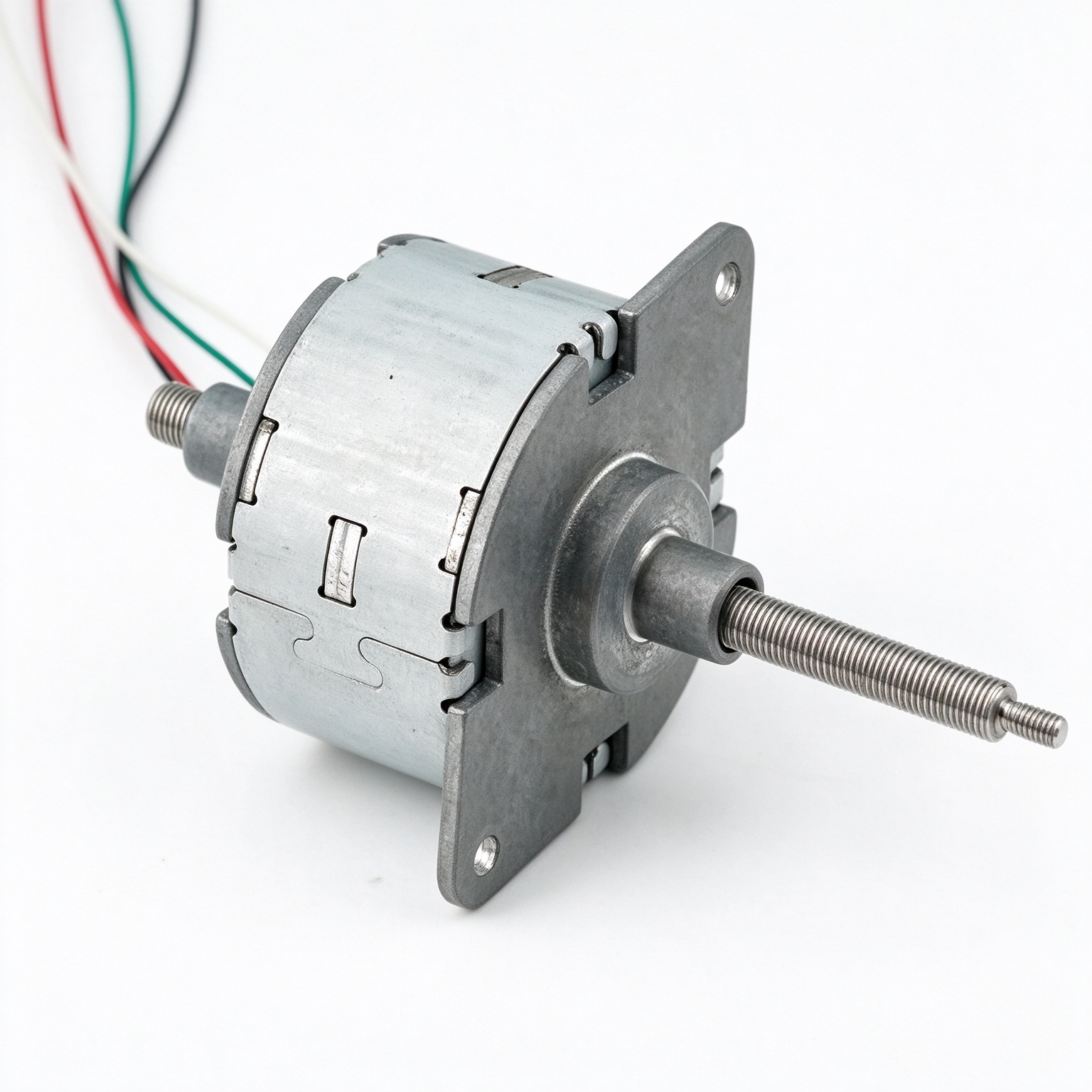
A permanent magnet linear stepper motor is a practical solution for equipment that needs accurate, repeatable linear movement. It combines a stepper motor with a lead screw to convert rotary motion into straight-line travel.
For buyers, Linear Motor Selection involves more than choosing a motor by its size. You also need to consider thrust, travel distance, speed, positioning accuracy and installation space.
This guide explains how permanent magnet linear stepper motors work, where they are used and how to select a suitable model for your application.
1. What Is a Permanent Magnet Linear Stepper Motor?
A permanent magnet linear stepper motor converts electrical pulses into controlled linear movement.
Inside the motor, a permanent-magnet rotor moves in small steps as the stator phases are energized. The rotor drives a lead screw, which converts rotation into straight-line movement.
As a result, the motor can move a load to a specific position, stop and repeat the movement. In many applications, an encoder is not required because the controller calculates position by counting pulses.
However, open-loop operation is suitable only when the load stays within the motor’s available torque. If the motor loses steps, the controller may not detect the position error.
A suitable motor should therefore match the actual load and motion requirements.
2. How Does a Permanent Magnet Linear Stepper Motor Work?
2.1 Rotor and stator movement
The stator contains electrical windings arranged in different phases. When the driver energizes these phases in sequence, they create a changing magnetic field.
The permanent-magnet rotor follows this field and moves from one stable position to the next. Each movement is called a step.
The controller determines the movement by sending pulses to the driver. The number of pulses controls the commanded distance, while the pulse frequency controls the motor speed.
2.2 The role of the lead screw
The lead screw converts the rotor’s rotation into linear movement.
For example, if the screw lead is 2 mm, one complete revolution moves the load by 2 mm. A smaller lead provides more travel resolution and can increase thrust at the same motor torque.
However, a smaller lead also reduces linear speed for a given rotational speed. Therefore, buyers should consider both force and speed when choosing a screw.
2.3 What is detent torque?
Detent torque is the small amount of torque that remains when the motor is not powered.
It can help resist unwanted movement when the driver is disabled. However, it is much lower than the holding torque produced by energized windings.
For this reason, detent torque should not be treated as a safety brake. Vertical applications may need a brake, counterbalance or verified self-locking screw arrangement.
3. Captive, Non-Captive or External: Which Type Should You Choose?
Permanent magnet linear stepper motors are available in different mechanical configurations. The right choice depends on the required stroke and the machine structure.
| Configuration | Working principle | Typical application |
|---|---|---|
| Captive | The screw stays inside the motor. An internal mechanism moves an extension shaft in and out. | Short strokes and compact equipment |
| Non-captive | The screw rotates and can move through the motor body. The load is attached to the screw. | Longer travel where the screw can pass through the machine |
| External | A rotating nut drives a fixed, non-rotating screw, causing the screw to move linearly. | Applications that need a fixed screw arrangement |
A captive design is useful when the actuator needs to be compact and self-contained.
In comparison, non-captive and external designs can support different installation and travel requirements. However, the machine must provide suitable guidance and support.
Before choosing a configuration, check the available space, required stroke and load guidance method.
4. What Determines Thrust, Speed and Resolution?
Three important factors affect the performance of a screw-driven linear stepper motor: thrust, speed and resolution.
4.1 Thrust
Thrust is the linear force that the motor can push or pull along its axis.
For a screw drive, an approximate relationship is:
Thrust ≈ (Motor torque × 2π × Screw efficiency) ÷ Screw lead
A smaller screw lead can produce greater thrust at the same motor torque. However, the actual result also depends on screw efficiency, friction and mechanical conditions.
Therefore, calculate the force needed by the real application rather than selecting a motor based only on its frame size.
4.2 Linear speed
Linear speed depends on the pulse frequency, the number of steps per revolution and the screw lead.
A higher pulse frequency can increase speed. However, motor torque usually decreases as step rate rises.
For this reason, check the dynamic torque curve at the required operating speed before making a final selection.
4.3 Positioning resolution
Resolution describes the smallest commanded movement.
For example, consider a motor with 200 full steps per revolution and a screw lead of 2 mm.
One revolution moves the load by 2 mm.
One full step moves the load by 0.01 mm.
One 1/8 microstep represents a commanded increment of 0.00125 mm.
Microstepping can make movement smoother and reduce vibration. However, it does not guarantee the same level of mechanical positioning accuracy. Friction, backlash and load conditions still affect the actual position.
5. Where Are Permanent Magnet Linear Stepper Motors Used?
Permanent magnet linear stepper motors are suitable for compact mechanisms that need controlled, repeatable movement.
5.1 Medical and laboratory equipment
These motors can be considered for dosing mechanisms, sample handling equipment and valve positioning systems.
Such applications may require short movements and repeatable positioning. However, the required cleanliness, materials and operating conditions should be confirmed for each device.
5.2 Office and document equipment
Printers, scanners and label machines may use linear actuators to move components or adjust paper paths.
In these applications, compact size, repeatability and cost are often important selection factors.
5.3 Industrial automation
Linear stepper motors can be used in indexing mechanisms, test fixtures, clamping systems and adjustable equipment.
For example, a clamping mechanism may need to move to a defined position and apply a controlled force.
5.4 Fluid and gas control
Valve and damper mechanisms may need accurate movement against spring force or pressure.
In this case, measure the force at the most demanding point of the movement. The initial force needed to open a valve may be higher than the force required during normal travel.
5.5 Home appliances
Air vents, louvers, dampers and other adjustment mechanisms may use compact linear actuators.
Here, installation space, noise and repeatability can be important factors.
6. How to Select the Right Linear Stepper Motor
Good Linear Motor Selection starts with the application requirements. Follow these six steps before choosing a model.
Step 1: Calculate the required load
First, consider all forces acting on the moving part. These may include friction, gravity, spring force and pressure.
For vertical movement, include the weight of the load. Also consider the force needed to accelerate the moving components.
Step 2: Define the movement requirements
Next, confirm the required stroke, movement time and number of operating cycles.
Also consider how long the motor must remain energized while holding its position. These details affect motor temperature and service life.
Step 3: Choose the screw lead
A smaller lead can provide greater thrust and finer movement increments. In contrast, a larger lead can provide greater linear speed.
Choose the lead according to the most important requirement of your application.
Step 4: Check the installation space
Measure the available mounting space before selecting the motor.
Check the motor diameter, overall length, screw length, mounting holes and cable direction. Also make sure the moving screw or extension shaft will not interfere with other machine components.
Step 5: Match the motor and driver
Check the rated voltage, winding current and driver compatibility.
The driver must supply the required phase current and support the intended pulse frequency. In addition, the controller must provide the correct pulse and direction signals.
Step 6: Check the operating environment
Finally, consider ambient temperature, dust, humidity, lubrication, noise and duty cycle.
If possible, test a sample under actual operating conditions before confirming the final design.
7. Common Mistakes When Selecting a Linear Stepper Motor
Even a suitable motor can perform poorly if important details are overlooked.
Here are some common mistakes to avoid:
Choosing by holding torque alone: Holding torque is measured when the motor is stationary. Check dynamic torque at the required speed.
Ignoring screw support: Long screws may vibrate or bend at high speeds. Check the mechanical limits and support requirements.
Forgetting load guidance: A non-captive screw needs a suitable arrangement to prevent the load from rotating.
Underestimating friction: Seals, guides and mechanical contact can increase the actual force requirement.
Ignoring backlash: Clearance between the screw and nut can affect positioning when the direction changes.
Using excessive holding current: Continuous high current can increase motor temperature during long stops.
Skipping sample testing: Actual load, mounting and operating conditions may differ from initial calculations.
Therefore, confirm the motor’s performance with a real sample whenever the application has demanding requirements.
8. Why Work with Changzhou Xinghua Electric?
Changzhou Xinghua Electric Co., Ltd. manufactures stepper motors and provides motor solutions for different equipment applications.
Our permanent magnet linear stepper motor range includes frame sizes such as Φ15, Φ20, Φ25, Φ36 and Φ46, with captive, non-captive and external configurations.
The suitable model depends on the required thrust, stroke, speed, installation space and electrical conditions.
For OEM projects, buyers can discuss:
Motor specifications and mechanical drawings.
Available screw leads and configurations.
Electrical requirements and driver matching.
Sample testing and application evaluation.
Motor selection based on the actual load and movement requirements.
If you are developing a new product, preparing the load information before contacting a supplier can make the selection process easier.
Visit Changzhou Xinghua Electric to learn more about our motor products and discuss your application requirements.
9. Frequently Asked Questions
9.1 What is the difference between a linear motor and a linear stepper motor?
A direct-drive linear motor produces linear force without using a rotary motor and lead screw.
A permanent magnet linear stepper motor uses a rotary stepping mechanism and a screw to create linear movement. The two designs have different structures and application requirements.
9.2 Does a permanent magnet linear stepper motor need an encoder?
Not always. Many applications use open-loop control, where the controller calculates position by counting pulses.
However, an encoder or other position sensor may be needed when missed steps could cause serious problems.
9.3 Can a linear stepper motor move vertically?
Yes, if the motor provides enough thrust to move the load.
However, the design must also address power-off holding requirements. A brake or counterbalance may be necessary if the load must not fall when power is removed.
9.4 What is the difference between captive and non-captive motors?
A captive motor has an internal moving extension shaft. A non-captive motor allows the screw to travel through the motor body.
The best choice depends on the required stroke, installation space and mechanical design.
9.5 How do I choose the correct screw lead?
Start with the required thrust, travel distance and movement time.
A smaller lead generally provides more thrust at the same torque, while a larger lead provides more travel per revolution. Check the motor’s torque and speed performance before making the final decision.
9.6 What causes noise and vibration?
Common causes include mechanical resonance, unsuitable step rates, loose mounting and excessive friction.
Microstepping, better mechanical support and a suitable movement profile may help reduce noise and vibration.
10. Conclusion
A permanent magnet linear stepper motor is a useful option for equipment that needs compact, repeatable linear movement.
However, choosing the right motor requires more than checking its dimensions. Buyers should consider thrust, screw lead, speed, resolution, stroke and operating conditions together.
Start with the actual load. Then choose the screw configuration and lead, check the motor and driver specifications, and test the design under real working conditions.
With the right selection, a linear stepper motor can provide a practical and cost-effective solution for many positioning applications.
For product information or OEM requirements, contact Changzhou Xinghua Electric Co., Ltd..
No related posts.